Same Beans, Different Drink: Espresso vs Filter
Same bag, two brewers, two different coffees. Why a shot tastes thick and chocolatey and a filter tastes light and clear, and how to pick the method that suits the way you drink it.
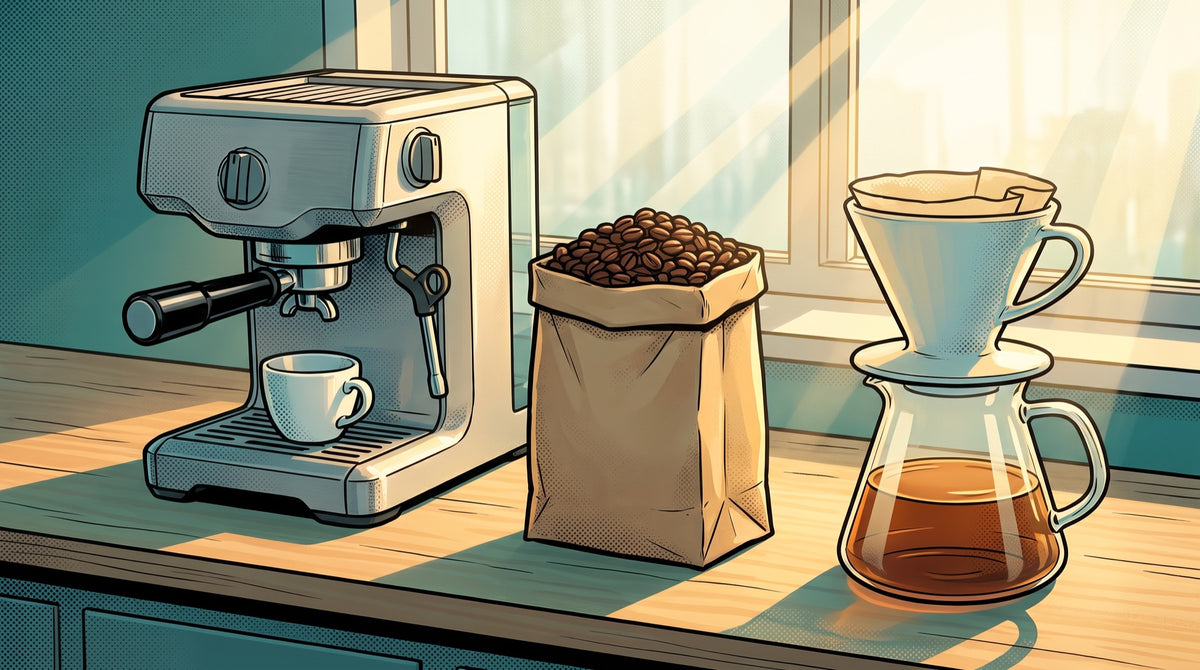
Same bag, two brewers, two different coffees. Pull it as a shot and it lands thick, sweet and chocolatey. Run the same beans through a paper filter and the cup comes out lighter and cleaner, with flavours you never noticed in the shot. Nobody swapped the bag.
That is the whole espresso vs filter question, and it trips up plenty of people at home. They love a coffee as a flat white, buy the beans, brew them in a pour over and wonder what they did wrong. Nothing. The method changed what they tasted.
Three things change between a shot and a filter. How much water goes through the coffee, what makes it into the cup, and how hard and how long the water works. None of them touch the beans. All of them change the drink.
Two related things already have their own posts, so we will keep them short here. The order flavour comes out of the grounds, sour first, then sweet, then bitter, lives in Grind Size, Explained. Which one carries more caffeine is in Caffeine, Honestly. This one is about flavour.
Espresso vs Filter: Three Things Change, the Beans Don't
1. The water. Our People Everyday espresso recipe is 20 grams of coffee in and 40 grams out. That is a 1:2 ratio. Our V60 recipe for the same blend is 15 grams of coffee to 250 mL of water, about 1:16.7. Gram for gram, the filter gets roughly eight times more water.
Think of cordial. Mix it strong and all you get is sweet and loud. Add more water and suddenly you can tell it is lime and not lemon. Coffee works the same way. In a concentrated shot the heavy flavours crowd the front, the roast, the chocolate, the bitter edge. Spread the same coffee through more water and the lighter, brighter notes get room to show up.
2. What gets through. An espresso keeps nearly everything. The oils, tiny particles of coffee too fine to see, and the gas trapped in fresh beans, which foams up as crema. That is why a shot feels thick, almost syrupy, and why the chocolate in it feels heavy.
A paper filter catches the oils and the fine particles. What drips through is clean and light, with less body for anything to hide behind, so the flavours sit apart from each other. It is the reason our V60 recipe post says the paper hides nothing.
3. Time and force. A shot takes 27 to 30 seconds. A pump drives hot water through a tight puck of coffee ground like caster sugar. A V60 takes about three minutes, with gravity pulling water through coffee ground like sand. Fast and forced gives you a small, dense drink. Slow and gentle gives you a big, open one. Both can be brewed perfectly. They are just built to show you different things.

One Blend, Two Recipes
Here is People Everyday both ways, straight from our brew guide.
| Espresso | V60 pour over | |
|---|---|---|
| Coffee | 20 g | 15 g |
| In the cup | 40 g | 250 mL of water through it |
| Ratio | 1:2 | About 1:16.7 |
| Grind | Fine, like caster sugar | Medium, like sand |
| Water temp | 93°C | 94°C |
| Brew time | 27 to 30 seconds | 2:45 to 3:30 |
| What reaches the cup | Oils, fine particles and crema | Clean coffee, the paper holds the oils back |
| How it drinks | Thick and dense, chocolate up front | Light and clear, flavours easier to pick apart |
Look at the water temperature. It barely moves. What changes the drink is how much water goes through, and what the filter lets past.

How We Taste It at the Roastery
Here is something most people don't know. Most of what we roast ends up in cafe espresso machines, poured into flat whites. But we don't judge a batch as a flat white. We taste every batch we roast as a cupping first.
Cupping is the plainest way there is to taste coffee. Grounds in a bowl, hot water poured over, a few minutes to steep, then tasted off a spoon. No machine, no pressure, no milk. It is much closer to a filter than to a shot, and that is the point. There is nothing for a batch to hide behind. If it tastes right in the bowl, it will hold up in the machine.
It also explains why every blend has its own filter recipe. Hyperdrive, our darkest, goes into the V60 at 18 grams to 250 mL at 90°C. People Everyday goes in at 15 grams and 94°C. Darker beans give up their flavour faster, so Hyperdrive gets cooler water, the same reason it runs cooler on the machine in How to Dial In Espresso at Home.

Which Method Suits Which Coffee
Drinking it with milk? Espresso. Milk needs a concentrated coffee to punch through it. Pour milk into a mug of filter and you get something pale and watery. That is why People Everyday is built for flat whites.
Love it heavy, sweet and chocolatey, black? A shot or a long black, with a blend that has some depth, like No Sleep Till Brooklyn or Hyperdrive.
Chasing lighter, fruitier flavours? Filter. Light roasts and fruity single origins can taste sharp and sour as a shot, then open right up through paper. That clean cup is where the delicate stuff shows.
Only one brewer at home? Brew what you have. Every one of our blends has a recipe for every method in the brew guide, and they are all built to taste good whichever way you go.
And if one way tastes off, it is usually the recipe, not the beans. A thin, sour filter wants a finer grind. A sharp shot wants dialling in. Neither means you bought the wrong coffee.
Try this on the weekend. Make the same coffee both ways, a shot and a pour over. Taste both black, then again five minutes later as they cool. Don't hunt for tasting notes. Just notice two things, how heavy it feels in your mouth and which flavour is loudest. Once you have tasted that difference side by side, you won't forget it.
The BOM Take
There is no one true taste of a coffee. The beans set what is possible. The method decides what you notice first.
So stop asking which one is right. Ask what you want this morning. A small, dense shot that stands up to milk, or a big clear mug you can sit with for a while. Same bag either way.
Keep reading: Grind Size, Explained · Pour Over at Home: The V60 Recipe · How to Dial In Espresso at Home · The Brew Guide
Want to taste what we're talking about? Check out our blends and we'll keep you sorted.
Written by Jos at Brother of Mine, specialty coffee roasters in Perth.
Keep reading
More from Ground Level.