Grinder buying guide · Updated October 2026 · 12 minute read
How to choose a commercial coffee grinder.
Your grinder decides what's in the cup. This is how to choose a commercial coffee grinder for your cafe: what's inside the box, why it drifts through a rush, what it really costs to run and how to keep it dialled in. Everything we tell a cafe before they buy, in about 12 minutes.
Know your volume already? Skip straight to the picks. Ready to buy? Talk to us.
Written by the Brother of Mine wholesale team in Port Kennedy, WA. We've roasted for Perth cafes since 2017.

01 · Why the grinder decides the cup
Pebbles and sand.
Espresso is water pushed through ground coffee at about 9 bar for under 30 seconds. The taste comes down to how much of the coffee that water dissolves on the way through, and the grind controls it more than anything else on the bench.
Pour water through a bucket of pebbles and it runs straight through, clear. Pour it through sand and it takes its time and comes out carrying everything it touched. Coffee works the same way. The machine holds the pressure and temperature steady, and that's its whole job. It can't change how fast the water gets through the coffee. Only the grind can, so the grinder is where every shot is won or lost.
Too coarse
Gushes in 15 seconds
Sour, watery, no body. The water rushed straight past the coffee.
Dialled in
Your recipe, on purpose
Sweet, round and a long finish. The water took its time and dissolved the right amount.
Too fine
Drips for 45 seconds
Bitter, dry and ashy. The water sat there and pulled out everything.
A grinder that can't hold the middle setting through a rush gives you all three in the same hour. That's what customers mean when they call the coffee inconsistent. A $25,000 machine on a $1,500 grinder is a race car on bald tyres.
02 · Inside the box
Four things matter.
The burrs, their size, how fast they spin and how hot they get. Five minutes on these and every spec sheet makes sense.
A commercial espresso grinder is a motor turning one burr against a fixed one. Beans fall between them and get cut smaller and smaller until they fit through the gap, and that gap is your grind setting. Burrs are the part that wears: sharp ones cut cleanly, blunt ones crush, throw off dust, run hot and take longer to dose.
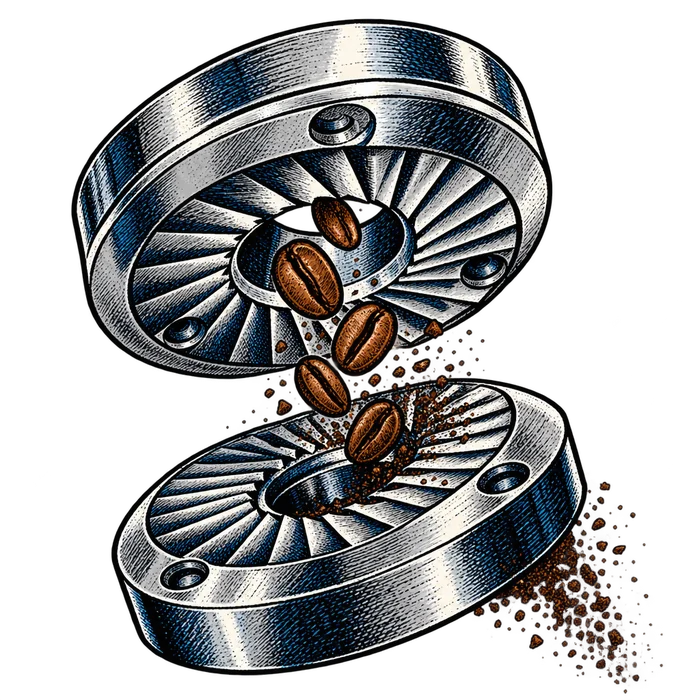
Flat burrs
Two rings face to face, spinning fast, around 1,400rpm. Even particles that taste clean and clear. Most of the field, and the speed makes heat, so the big ones carry fans.
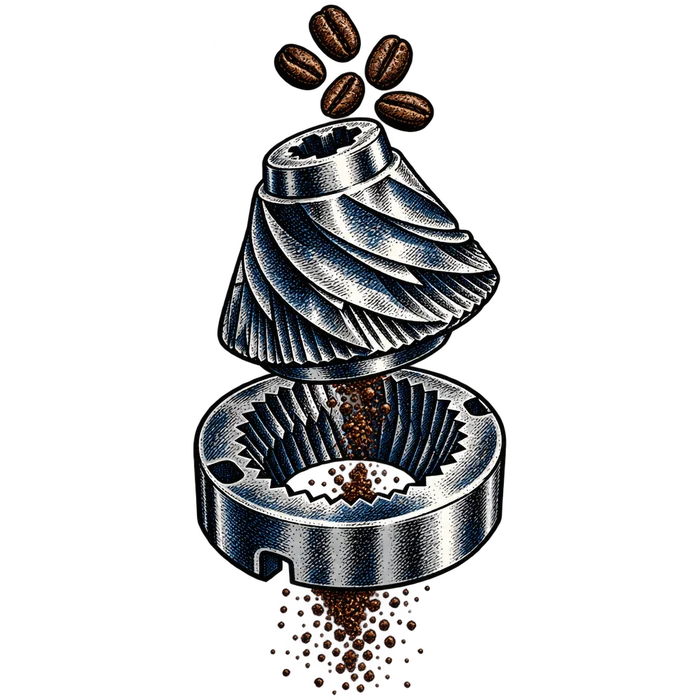
Conical burrs
A cone inside a ring, spinning slow, 300 to 420rpm on the big ones. Cooler and quieter, and less coffee stays behind. A wider spread of particles that tastes like body.
Neither is better. Your volume decides it. Under 350 coffees a day a good flat does everything. Over that, a big conical or a big flat with a fan.
Size and speed
Burrs run from about 58mm to 85mm. Bigger burrs grind each dose faster, spread the work over more steel, run cooler and last longer. A double in 2 seconds gets you through a queue. In 5 seconds it doesn't, and you'll feel it at 9am.
Heat
Grinding makes heat. The grounds leave about 10°C warmer than the beans went in, and 50°C and up through a rush. In a BeanScene test, 2kg through a grinder pulled the same setting up to 12 seconds faster. The 7am shot is gushing by 10.
Retention
The ground coffee left inside when the motor stops. The next dose pushes it out first, so the first shot after a quiet spell is partly stale. Aim for under 2g. Most makers don't publish it, so weigh it yourself (chapter 6).
03 · Timer, doser or grind by weight
Half a gram a dose.
How the grinder decides how much coffee lands in the basket will cost you more over five years than the difference between any two brands.
Doser
A chamber and a lever
Grinds into a box ahead of the queue and you pull a lever to drop it. Stale grounds sit waiting. Fine on a deli counter. On an espresso bar it's a box of stale coffee.
Timer
A set number of seconds
Grinds for, say, 2.4 seconds and hopes the same weight falls out. A full hopper against a near empty one can shift the dose by up to 1.5g, and a step finer can drop 18g to 16g.
Grind by weight
A scale under the fork
Stops the grind at the gram, whatever the beans and burrs are doing. About $1,000 more than the timer version of the same grinder.
Set the kilo price to what you pay. Assumes 7 days a week and about $1,000 between the timer and grind by weight versions. Half a gram is the polite number: in one published 20 dose test, a timer grinder averaged 0.6g under target and the grind by weight version landed within 0.1g.
Under about 100 coffees a day, a timer grinder and a barista who weighs every shot make a good bar, and the $1,000 is better spent on a second grinder. Over 150 the maths turns. By 200 it isn't close.
04 · Size it right
Size it for your busiest hour.
Every coffee is about 20g through the burrs, so 200 a day is 4kg. But a grinder doesn't spread that over ten hours. It does a third of the day in the worst 60 minutes, and that's the hour a small grinder runs hot and drifts.
A 64mm grinder is happy to about a kilo an hour, around 50 coffees. Push past that every Saturday and it warms up, the grind opens and the drift starts. No barista can fix that. Bigger burrs can. Opening a new site? Size it for where you expect to be in 12 months. The quiet first month won't last.
Too small
Hot, drifting, bought twice
It runs hot at peak, the shots go sour then bitter in the same hour, and your barista chases the dial instead of the queue. Within 18 months you buy again and sell the small one for a third of what you paid.
Too big
Stale hopper, sleepy burrs
A big conical with a 1.6kg hopper on a bar doing 3kg a week. Half a week of beans sitting above the burrs, stale grounds in every first shot, and $2,000 you didn't need to spend.
On the line between two bands? Go up. Too big is a habit you can fix. Too small is a cheque.
Find your band in the top 1005 · Burrs are a running cost
Burrs wear out. Budget for it.
Every burr set has a life in kilos, and the spec sheet never says when it ends. A dull set doesn't stop working. It grinds slower, runs hotter and drifts for a month or two before anyone says anything, and the first to notice is usually a regular who stops coming in.
The set price is a placeholder, so ask your supplier for the real fitted price. Retailers often quote fewer kilos than the makers do: treat the maker's number as a ceiling and start checking the burrs at half their rated life.
Two questions before you pay: what are the burrs rated for in kilos, and what does a fitted set cost? The bigger set costs more on day one and less every year after. And don't pay for titanium on a grinder doing 3kg a week. Steel will outlast your lease.
06 · Hopper and freshness
Load for the day, not the week.
Whole beans in a sealed bag stay good for weeks. In an open hopper above a warm grinder, a day or two. Ground, minutes. The hopper is where most bars quietly throw away the freshness they paid for.
- Load for the dayThe bag is the storage. The hopper is the queue.
- Keep it half fullA steady feed for a timer, and no stale layer at the bottom.
- Empty it at closeBack in the bag, sealed. Beans don't sleep in the hopper.
- Purge after a breakAfter 20 quiet minutes, purge into a cup on a scale. What comes out is your retention.
- Wash it weeklyCoffee oil goes rancid on the plastic. Warm soapy water, then dry it completely.
Single dosing, weighing every dose in by hand with an empty hopper, is the freshest way to work and the slowest. Save it for a guest single origin on a second grinder. It won't keep up with a Saturday rush.
07 · You need two grinders
Run two. Always.
House and decaf
House blend on one, decaf or a guest coffee on the other. Swapping beans in one grinder means purging every time: a shot of waste, a minute of noise and a queue watching.
Your insurance
Grinders die at 9am on a Saturday. With two, the house blend moves across and nobody outside the bar knows. With one, the coffee side shuts until the service van turns up, and in WA that can be Monday.
One band smaller
The second grinder runs decaf all week and the house blend on the day the big one's away. A 58 to 64mm timer grinder does it for under $2,500. From 350 a day up, make it a second station the same size as the first.
Batch brew on the menu? Give filter its own grinder, set coarse and never touched.
08 · Dialling in
Dial in once, not all day.
The right grinder doesn't dial itself in. It makes dialling in a morning job instead of an all-day fight. The routine goes like this.
- PurgeRun it for a second and bin what comes out. That's last night's retention.
- Weigh the doseOn a timer, adjust the seconds until you're on your dose and write it down. On grind by weight it's a check.
- Pull a shot on a timer and a scaleDose in, weight out, time. Our brew guide has the recipe for every blend.
- Move the grind, not the doseFast and thin, go finer. Slow and bitter, go coarser. Small steps, and purge two doses after each change.
- Taste itThe numbers get you close. Sweet and balanced at the recipe? Write the setting on the board.
Through the day, a grinder that's the right size needs a small nudge around 10am and maybe one more at 2. A new roast date is a re-dial. A new blend is a full dial-in, done before the doors open.
The one habit: weigh every dose, every shot, on every grinder.
09 · Cleaning and service
Most grinder problems are cleaning problems.
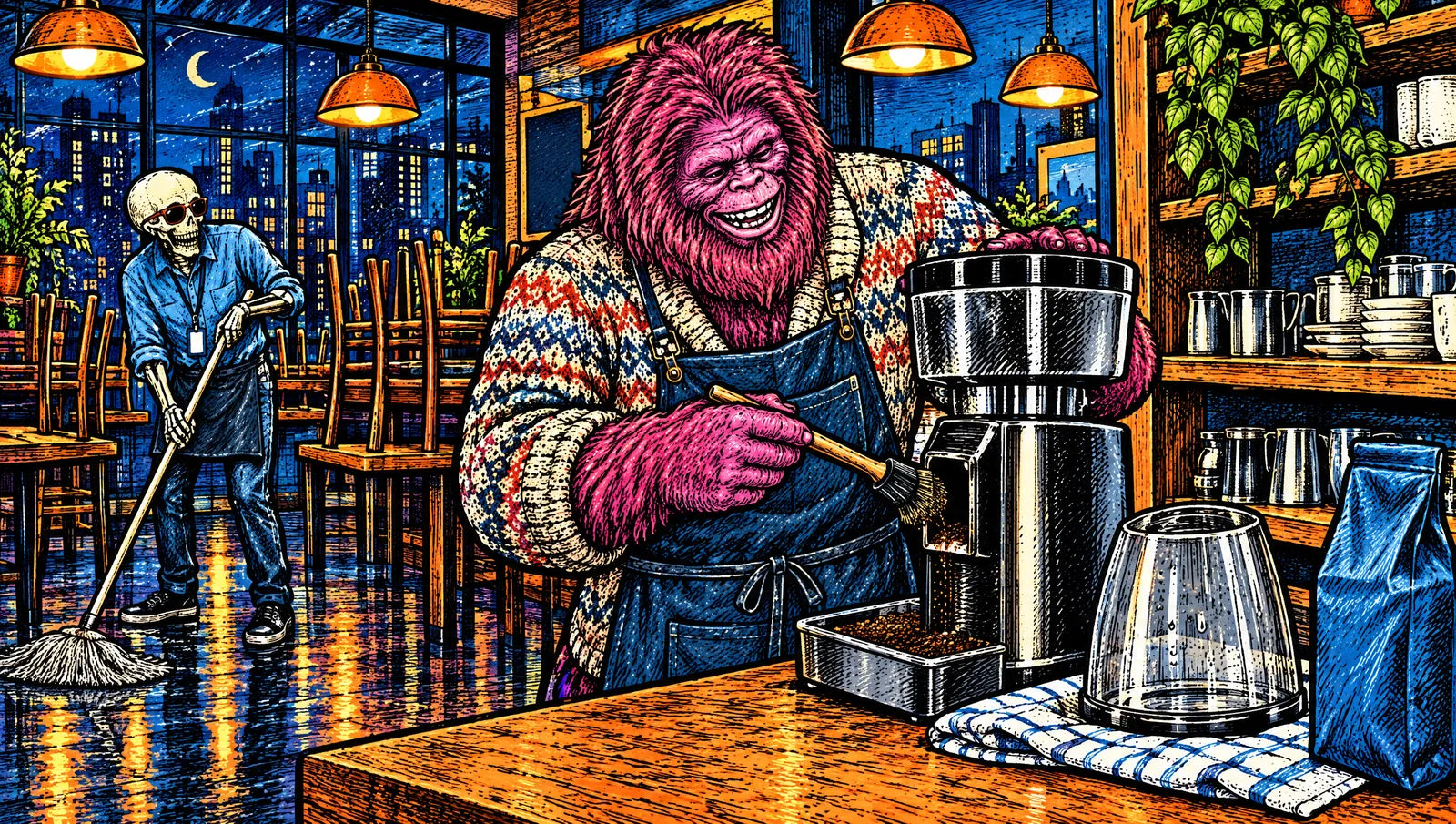
Coffee is oily and grinders are warm. Left alone, the oil goes rancid on the burrs and chute and taints every dose after it. Put this on the closing checklist and it happens.
Every close
- Empty the hopper back into the bag
- Brush out the chute and fork, 30 seconds
- Wipe the body with a damp cloth
Every week
- Wash and fully dry the hopper
- Cleaning granules through the burrs if your maker approves them, then purge
- Top burr carrier off, brush and vacuum the chamber. Mark the collar first
Every month
- Burrs out, chute and fork stripped, fan grille cleared
- Check the edges: a fingernail catches on a sharp burr and slides off a blunt one
Mazzer's rule: no water or liquid cleaners on the burrs, just a brush and a vacuum. And never grind rice through it. It isn't a cleaning product, and it can cost you a motor.
Signs the burrs are done
- The dose takes longer: 2 seconds became 3
- It runs hot by mid morning
- You keep going finer and it still runs fast
- The grounds come out in clumps
- The cup went flat
Before you buy, get the name of the brand's WA service agent, ask where their workshop is and whether they lend you a grinder while yours is in. A grinder that goes to Melbourne for a bearing is a three week hole in your bar. Buy through us and the WA service comes with it.
10 · Before you pay
New, used, bundled or free.
New
Full warranty, known burr life and a service agent who's seen it before. The right answer for your house grinder.
Used
A five year old Major or Robur from a closed cafe can be great value as a second grinder. Budget a new burr set on day one, check the collar turns and locks, listen to the motor, and ask why they're selling.
Bundled
The grinder is where machine deals get made to look good. Check it against your band, then ask for the bundle price without it.
Free
A grinder for nothing in exchange for a coffee contract is a loan, with your coffee as the interest. Read the term and the volume, and find out whose grinder it is when it breaks.
Ten questions to ask before you sign
- What are the burrs rated for in kilos, and what does a fitted set cost? Those two numbers turn the price into the real price.
- Who services it in WA, and where's the workshop? Melbourne is not an answer.
- Do I get a loaner while it's in for service? If not, your second grinder is the loaner.
- What's the real lead time today? A six week wait in opening week is avoidable.
- What does the warranty cover, and does it cover burrs? Burrs are usually excluded.
- Does the fork fit my portafilter? One that doesn't is a barista holding a handle in mid air 300 times a day.
- Are spares held here? A hopper lid three weeks away stops a bar.
- How loud is it? Run it in the showroom. It runs 200 times a day next to your customers.
- Does it fit under my shelf with the hopper on? Measure the bench and the shelf.
- How much does it hold between shots? Under 2g is good. Over 5g is a purge every quiet stretch.
Our position: we supply grinders at recommended retail with WA service behind them, and we don't tie your grinder to your coffee contract.
Talk to us about buying oneBuying a grinder? Talk to us.
We supply every grinder in our top 10 at recommended retail, with WA service behind it. Tell us which one you're after, or how many coffees you pour and we'll help you choose. Leave your details and we'll be in touch to arrange a time. No obligation, and no coffee contract tied to it.
 Jos
Jos Dan
DanYou get one of us. Grinder, machine and bar layout for new venues, before you spend a dollar.
Ready to pick one? See the 10 best commercial grinders. Opening a cafe from scratch? Start with the cafe startup guide.