Why Your Kettle Matters More Than You Think
Your kettle matters more than you think. Temperature, gooseneck vs regular, and which to buy for every brew method. From a working roastery.
Your Kettle Is Sabotaging Your Coffee
You could have the best beans on the planet, a $400 grinder, and a recipe dialled to perfection. If your kettle is dumping boiling water straight onto the grounds, you're burning your coffee every single morning.
Nobody talks about kettles. It's not sexy. It's not the grinder debate or the espresso machine rabbit hole. But water temperature is one of the three biggest variables in extraction. And your kettle is the thing controlling it.
We set our commercial kettles at the roastery to 93°C. Not 100. Not "just boiled." Ninety-three. There's a reason for that, and it applies to your kitchen too.
What Boiling Water Actually Does to Coffee
Here's something only people who cup coffee for a living tend to know. Water temperature doesn't just make coffee "stronger" or "weaker." It changes which compounds get extracted and how fast.
Coffee grounds contain hundreds of soluble compounds. The sweet, fruity, caramel stuff dissolves first. The bitter, ashy, dry stuff dissolves last. Temperature is the accelerator pedal.
At 100°C, extraction rips through everything fast. You blow past the good stuff and slam straight into the harsh, over-extracted territory. That's why boiling water makes coffee taste bitter and flat. It's not opinion. It's chemistry.
Drop to 92-96°C and you slow extraction down just enough to pull the sweetness and complexity without dragging the bitterness out with it. That's the window. That's where good coffee lives.
At the roastery, we cup every batch at exactly 93°C. Our Brewista kettles are set there permanently. When a batch tastes off, we know it's not the water. We've eliminated that variable. You can do the same thing at home for under $100.
Temperature Control vs Guessing
Most people's method for water temperature is "boil the kettle and wait a bit." That's fine. It's better than pouring at a rolling boil. But "a bit" is doing a lot of heavy lifting in that sentence.
Thirty seconds off the boil gets you to roughly 96°C. A minute gets you closer to 92°C. Two minutes and you're dropping below 90°C, which is too cool for most brew methods. The problem is every kitchen is different. Ambient temperature, kettle material, how much water is in there. "Wait 30 seconds" is a rough guide at best.
A kettle with a temperature display removes all the guessing. Set it. Wait for the beep. Pour. Done.
You don't need to spend $200 on this. The Bonavita Variable Temperature kettle does it well for around $80-100 and has been a cafe industry workhorse for years. The Fellow Stagg EKG is the one you see on every barista's Instagram for around $200. Both hold temperature. Both display it. Both are miles ahead of guessing.
Even a basic thermometer stuck in your existing kettle for $10 tells you more than your gut does.

Gooseneck vs Regular: Do You Actually Need One?
The gooseneck kettle has become the symbol of good home coffee. Sleek. Precise. Looks great on the bench. But here's the thing most gear reviews won't tell you: whether you need one depends entirely on what you're brewing.
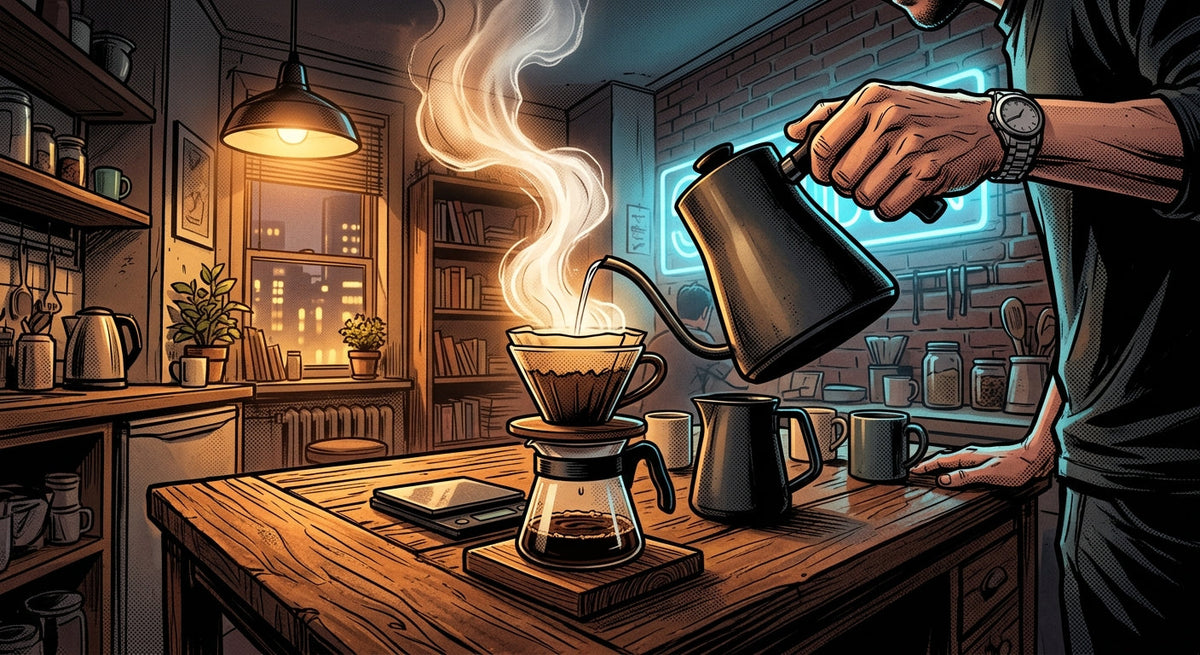
You need a gooseneck for pour-over. V60, Chemex, Kalita Wave. Any method where you're pouring water directly onto a bed of grounds in a controlled, circular pattern. The thin spout gives you flow control. You can pour slowly and evenly, which means even extraction across the whole bed. Try that with a regular kettle and you'll get a fat, uncontrollable stream that blasts a hole in the grounds and channels water down one side. Uneven extraction. Bitter in some spots, sour in others.
You don't need a gooseneck for immersion brewing. Plunger, AeroPress, cupping. These methods work by soaking the grounds in water for a set time. You just need to get the water in there. Pour control doesn't matter because the grounds are fully submerged anyway. A regular kettle does the job perfectly.
Espresso machines have their own boiler. Your kettle isn't even in the equation. The machine heats and delivers the water. Spend your money on a better grinder instead.
The Best Kettle for Coffee (Honest Breakdown)
We get asked this constantly. Here's what we actually recommend based on how you brew.
If you only use a plunger or AeroPress: You don't need a gooseneck. Get any kettle with temperature control. The Breville Smart Kettle does variable temp for around $100 and it's a regular pour spout. Perfect for immersion methods. Or honestly, your existing kettle plus 30 seconds of patience after boiling gets you 90% of the way there.
If you brew pour-over: Get a gooseneck with temperature control. The Brewista Artisan is what a lot of specialty cafes use for their filter bar. Around $120-150. Rock solid. The Fellow Stagg EKG is the premium option at around $200. Beautiful design, holds temp well, Bluetooth on some models if you're into that. The Hario Buono is the budget gooseneck if you don't need temp control (around $60-80), but you'll be guessing on temperature.
If you brew everything: Get a gooseneck with temp control. It works for all methods. You can pour slowly for a V60 and dump it in for a plunger. The Brewista or Fellow Stagg covers every base.
If you're on a tight budget: The $30 Kmart kettle with no temperature control is fine. Genuinely. Boil it, wait 30-45 seconds, pour. You're making better coffee than someone with a $200 kettle and stale supermarket beans. Fresh beans matter more than any piece of equipment. We will always tell you that.

How Temperature Hits Different Brew Methods Differently
This is the bit that most guides skip. The ideal water temperature isn't the same for every brew method because the grind size and contact time change the extraction dynamics.
Pour-over (V60, Chemex): 92-96°C. Medium grind, short contact time. You want the water hot enough to extract efficiently as it passes through. Too cool and you'll get sour, underdeveloped flavour.
Plunger: 94-96°C. Coarse grind, 4-minute steep. The long contact time means extraction happens gradually. You can afford slightly hotter water because the coarse grind slows things down. But 100°C is still too hot.
AeroPress: 85-92°C. This is the wildcard. The AeroPress is forgiving because the brew time is short (1-2 minutes) and the pressure helps. A lot of competition-winning AeroPress recipes use water as cool as 80°C. Play with it.
Dark roasts across all methods: Drop 2-3°C from whatever you'd normally use. Dark roasted coffee is more soluble. The cell structure is more broken down from longer roasting, so it extracts faster. Hit it with the same temp as a light roast and you'll over-extract. We run our Hyperdrive at 90°C on espresso and around 90-92°C for filter. People Everyday runs at 93-96°C.
The Stuff Nobody Mentions
Preheat your brewer. Whatever you're brewing into, pour some hot water through it first and dump it. A cold ceramic V60 or a cold glass plunger will steal 3-5°C from your brew water on contact. That's enough to change the cup. Takes 10 seconds. Do it every time.
Don't reboil the same water. This gets debated endlessly online. The practical difference is small, but freshly drawn water has more dissolved oxygen which contributes to a livelier cup. It's a marginal gain. But if you're already weighing your coffee and nailing your temperature, this is the next 1%.
Altitude matters if you're not at sea level. Water boils at a lower temperature the higher you go. In Perth we're basically at sea level so it's 100°C. But if you're brewing at altitude in the mountains or on a ski trip, your "boiling" water might only be 95°C. Your "wait 30 seconds" trick might drop you too cool. Temperature display solves this.
The Honest Truth
A kettle upgrade is one of the cheapest, highest-impact improvements you can make to your home coffee setup. Not because it's magic. Because it removes guessing from the one variable that affects every single cup you make.
Fresh beans first. Always. A decent grinder second. And then a kettle that gives you control over your water temperature. That's the trifecta. Everything after that is fine-tuning.
You don't need the most expensive option. You need the one that tells you what temperature the water is so you can stop guessing and start brewing with intention.
Brewing starts before the kettle boils.
Check our full brew guide for method-by-method recipes. Or browse our brew gear if you're ready to upgrade your setup.
Keep Reading
- The Plunger Is Underrated. The recipe we give our cafes. Simple method, big results.
- How to Dial In Espresso at Home. The exact recipes we use at the roastery. Dose, yield, time.
- We Tested Grinders Under $500. Real grinders, real tests, honest verdicts.
- Brew Guide. Our full brewing reference for every method.
Written by Jos at Brother of Mine, specialty coffee roasters in Perth.
Keep reading
More from Ground Level.