We Tested Grinders Under $500. Here's What Actually Matters.
We tested 5 grinders under $500 at the roastery. Burr size, retention, consistency. Here's what actually matters and our pick.
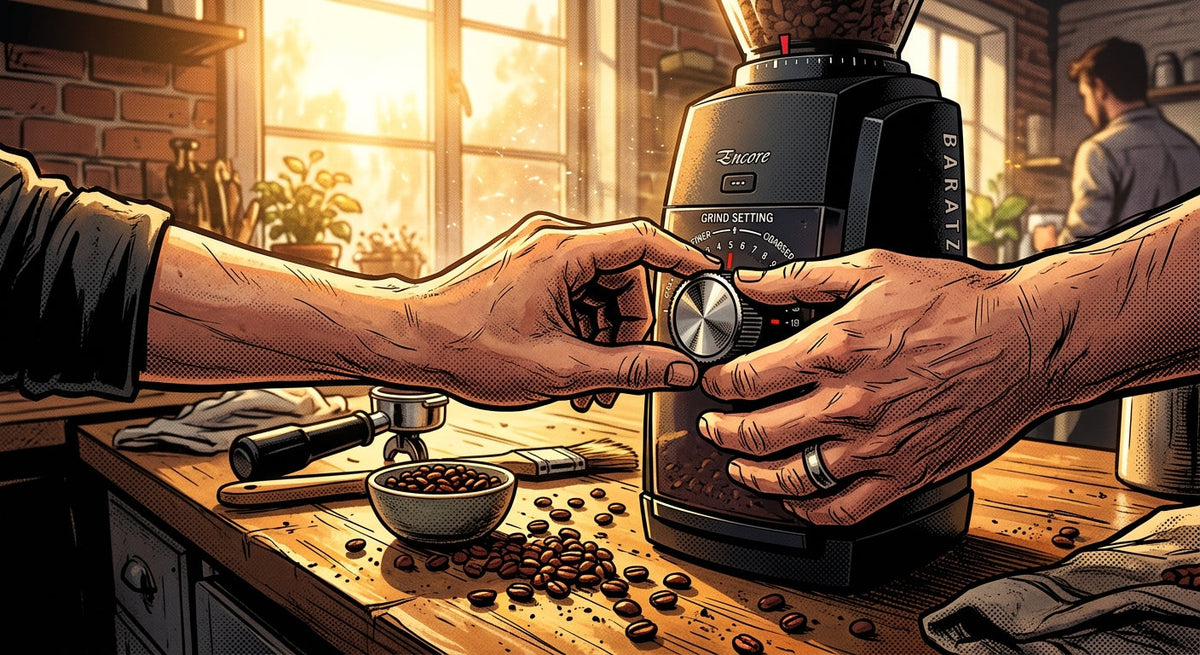
Finding the best coffee grinder under $500 is the single most useful thing you can do for your coffee, and almost everybody spends that money on a machine instead.
We tested these on the bench at the roastery and at home, next to the commercial gear they are trying to imitate. Here is what actually separates a good grinder from a bad one at this price, and which ones are worth your money.
Your Grinder Matters More Than Your Machine
We're going to say something that will upset a lot of people who just spent $2,000 on an espresso machine. Your grinder is doing more work than your machine is. By a long way.
A $500 grinder paired with a $400 machine will outperform a $2,000 machine paired with a $100 grinder every single time. We see it constantly. Someone drops serious money on a beautiful machine, then grinds their beans with whatever was on sale at Target. The shots taste average and they blame the beans.
It's not the beans. It's the grinder.
What Actually Matters in a Grinder
The coffee internet will have you comparing RPM speeds, motor wattage, build materials, Wi-Fi connectivity, and whatever else marketing departments dream up. Here's what we actually look at when we test grinders at the roastery.
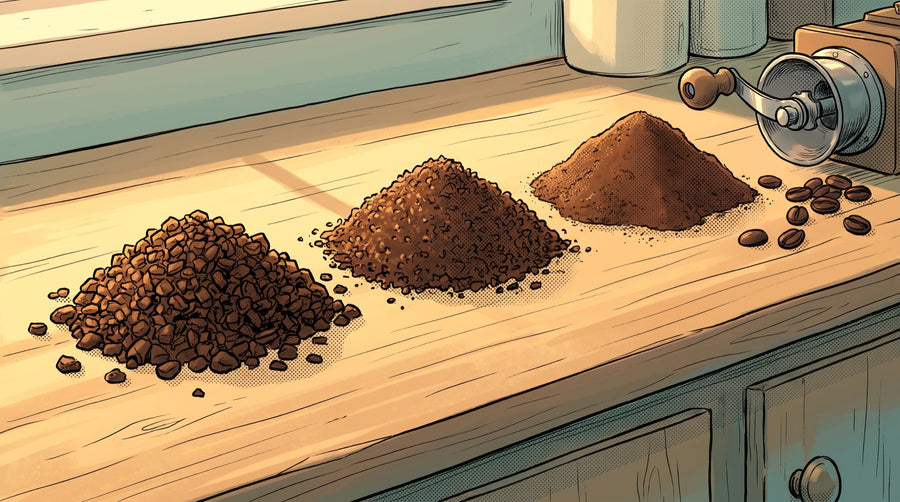
Grind consistency. This is the whole game. You want every particle roughly the same size. When particles are mixed (some fine powder, some chunky boulders), water extracts unevenly. The small bits over-extract and taste bitter. The big bits under-extract and taste sour. You get both in the same cup. That muddy,"not quite right" flavour most people accept as normal? That's inconsistency.
Burr size. Bigger burrs grind more evenly. That's not marketing, that's geometry. A 40mm burr has to spin faster to get through the same amount of coffee as a 58mm burr. Faster spinning means more heat. More heat means static. Static means grounds clumping and sticking everywhere except your portafilter. Bigger burrs also have more cutting surface, so each revolution does more work with less stress on each particle. If you're choosing between two grinders at the same price and one has bigger burrs, buy that one.
Retention. This is the one only working roasters talk about. Retention is how much ground coffee stays trapped inside the grinder after you're done grinding. On our Mahlkonig EK43s at the roastery, retention is under 1 gram. On a cheap home grinder, it can be 3 to 5 grams. That means every time you grind, you're getting a dose that's part fresh grounds and part stale grounds from yesterday. Or last week. You're blending fresh coffee with dead coffee and wondering why your shots are inconsistent.
We purge our commercial grinders between every single batch. At home, you should too. Run 2 to 3 grams through and throw them away before you grind your actual dose. It's wasteful, yes. But if your grinder retains 4 grams, those 4 grams of stale coffee are going straight into your cup otherwise.

Flat Burrs vs Conical Burrs
You'll hear people argue about this like it's a religion. Here's the short version.
Flat burrs grind more uniformly. The particles come out closer in size. This gives you a cleaner, more transparent cup where you can taste individual flavours clearly. Most commercial espresso grinders use flat burrs. Ours do.
Conical burrs produce a wider range of particle sizes. This sounds bad, but it creates more body and texture in the cup. A lot of people actually prefer this, especially for milk drinks. Conical grinders also tend to run cooler, quieter, and retain less coffee.
Neither is wrong. For espresso purists chasing clarity, flat burrs win. For everyday home use where you're making lattes and long blacks, conical burrs are brilliant and often cheaper.

The Grinders We Actually Recommend
We've used all of these. Not just pulled a shot and moved on. We've run them daily, cleaned them, dialled them in with our blends, and tracked how consistent they are over weeks. Here's where they land.
| Grinder | Price (AUD) | Burr Type / Size | Retention | Verdict |
|---|---|---|---|---|
| Baratza Encore ESP | ~$280 | Conical / 40mm | ~1.5g | Best entry point. Does espresso and filter. Not razor-sharp for light roasts but handles medium and dark roasts well. Great first grinder. |
| Breville Smart Grinder Pro | ~$350 | Conical / 40mm | ~2.5g | Lots of grind settings. Decent for the price. Higher retention is the trade-off. Good for Breville machine owners who want one ecosystem. |
| Timemore Sculptor 064 | ~$400 | Flat / 64mm | ~0.5g | Our pick under $500. 64mm flat burrs at this price is unheard of. Near-zero retention. Punches way above its weight. This is what we'd buy. |
| DF64 Gen 2 | ~$480 | Flat / 64mm | ~0.3g | Best in class for espresso at this budget. Extremely low retention. Accepts aftermarket burrs if you want to upgrade later. The serious option. |
| 1Zpresso J-Max (Manual) | ~$300 | Conical / 48mm | ~0.1g | Best grind quality per dollar. Period. Manual effort is real (45 seconds of cranking) but the grind is cleaner than electric grinders twice the price. Travels anywhere. |
If you asked us to spend our own money on one grinder under $500 for home espresso, it's the Timemore Sculptor 064 or the DF64 Gen 2. Both have 64mm flat burrs, negligible retention, and grind quality that competes with machines costing three times as much.
If you don't mind the manual work, the 1Zpresso J-Max gives you commercial-level consistency for $300. We've taken one camping and pulled shots that tasted better than half the cafes in Perth. No exaggeration.
What We Use Commercially (And Why It Doesn't Matter for You)
At the BOM roastery we run Mahlkonig EK43s for quality control and cupping. They're the industry standard for a reason. Near-zero retention, massive 98mm flat burrs, insanely uniform grind. They also cost $4,000 each.
We're not telling you this to flex. We're telling you because when we test home grinders, we're comparing them against a benchmark we use every day. We know what a perfect grind looks like because we stare at it for hours. When we say the Timemore and DF64 are impressive for the price, we mean they hold up against equipment that costs eight times more.
Your Probat-roasted BOM coffee deserves a grinder that can actually do it justice. A $40 blade grinder is taking specialty-grade beans and turning them into a random assortment of dust and chunks. That's not grinding. That's destruction.
The One Upgrade That Changes Everything
If you already have a grinder and you're not ready to replace it, do this one thing. Weigh your dose before and after grinding.
Put 18 grams of beans in. Weigh what comes out. If you're only getting 15 grams out, you've got 3 grams of retention sitting inside the grinder. That's 3 grams of stale coffee going into your next shot tomorrow.
Purge it. Run a few extra grams through and discard them. Or tap the grinder firmly after grinding. Some people use a bellows attachment to blow the last grounds out. Whatever works. Just know that what stays inside is working against you.
Pair that awareness with a proper dialling-in process and you'll get noticeably better results from whatever grinder you already own.
Stop Overthinking It
Here's the buying framework. Three questions.
Budget under $300? Baratza Encore ESP (electric) or 1Zpresso J-Max (manual). Both solid. The manual option grinds better but requires effort.
Budget $300 to $500? Timemore Sculptor 064 or DF64 Gen 2. These are the sweet spot. You'll have a grinder you won't need to upgrade for years.
Only doing filter or plunger? You need less precision than espresso. The Baratza Encore (non-ESP) or even a good hand grinder will do beautifully. Check our brew guide for grind size targets by method.
Don't let anyone tell you that you need to spend $1,000 on a grinder to make good coffee at home. You don't. The sub-$500 market has exploded in the last two years. Grinders that would have cost $900 three years ago are now $400. Take advantage of it.
Good grinder. Good beans. That's the formula.
Grab a bag of our signature blends, grind them fresh, and taste the difference. Roasted on our Probat here in Perth and shipped fast so the freshness is actually there when you open the bag.
Keep Reading
- How to Dial In Espresso at Home. Get your grind, dose, and timing locked in without losing your mind.
- How to Store Coffee So It Actually Stays Fresh. You fixed the grinder. Now stop ruining your beans with bad storage.
- The Plunger Is Underrated. The simplest brew method nobody talks about. No machine required.
- Brew Guide. Our full brewing reference for every method.
Written by Jos at Brother of Mine, specialty coffee roasters in Perth.
Keep reading
More from Ground Level.