How to Store Coffee So It Actually Stays Fresh
Your coffee goes stale 14 days after roasting. Here's exactly how to store it right. One canister and a dark cupboard. That's the whole system.
Your Coffee Is Going Stale Right Now
Here's the thing nobody tells you at the register. Coffee starts losing flavour about 14 days after roasting. Not months. Not"when it smells funny." Two weeks.
After that, the oils that give your cup all its character start breaking down. Oxygen gets in. Moisture creeps in. And that bag of beans you spent good money on starts tasting like cardboard.
We roast thousands of kilos a month for over 100 cafes across Perth. We've tested every storage method going. Here's what actually works and what's a waste of time.
Why Your Coffee Bag Has That Little Valve
Ever noticed the small circle on your BOM bag? That's a one-way degassing valve. Fresh-roasted coffee releases CO2 for days after roasting. The valve lets that gas out without letting oxygen in.
This is something most home coffee drinkers never think about. We ship every bag with this valve because it's the difference between beans arriving fresh and beans arriving bloated and stale.
But here's the catch. Once you rip the bag open, that valve is useless. The seal is broken. Oxygen is in. The clock is ticking faster now.

The Four Enemies of Fresh Coffee
Oxygen. The big one. Oxidation is what kills flavour compounds. Every time you open the bag, more oxygen gets in.
Moisture. Coffee is hygroscopic. It absorbs moisture from the air. Damp beans extract unevenly and taste flat.
Heat. Warmth accelerates every chemical reaction that degrades your beans. That shelf above your kettle? Worst spot in the kitchen.
Light. UV breaks down the same oils that give coffee its aroma. Clear glass jars on the counter look nice. Your coffee doesn't care about aesthetics.
Storage Methods Compared
| Method | Oxygen Blocked? | How Long It Keeps | Verdict |
|---|---|---|---|
| Original bag with clip | Barely | 5-7 days after opening | Fine for a week. Not great beyond that. |
| Mason jar / glass canister | Somewhat | 7-10 days | Better seal, but still traps oxygen inside. Light gets in too. |
| Regular"airtight" canister | Mostly | 10-14 days | Better than jars. But"airtight" doesn't mean no air inside. |
| Vacuum-sealed canister | Yes | 3-4 weeks | Best option. Pushes air out every time you close it. |
The difference between a regular canister and a vacuum canister is bigger than most people expect. A regular canister seals the lid. A vacuum canister actually forces the air out. Every time you close it, it pushes oxygen away from your beans. That's a completely different thing.

Why We Think the Airscape Is the Best Thing Going
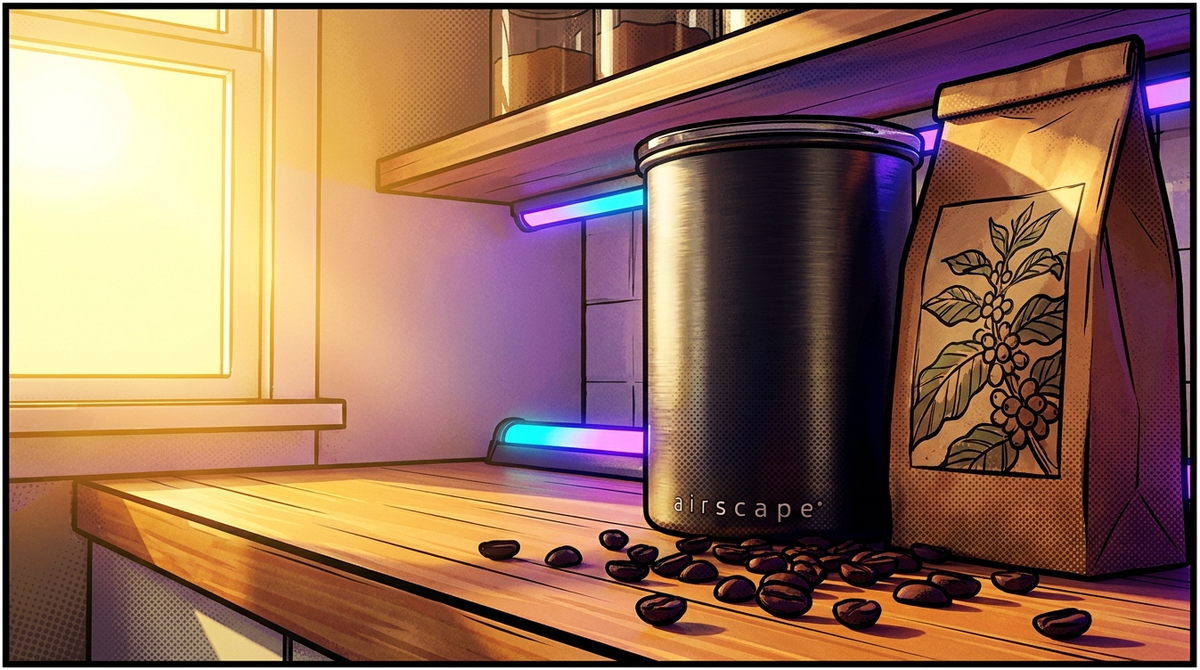
We've tried a lot of canisters. Cheap ones, expensive ones, ones with fancy valves, ones that look good on a shelf. The Airscape is the one we keep coming back to. It's the one we actually use at home. Every day.
It works differently to most canisters. Instead of just sealing the top, it has an inner lid that pushes down directly onto the beans and forces the air up and out through a valve. There's almost zero oxygen left inside. Your beans sit in a near-vacuum environment between uses.
The result is measurable. Coffee stored in an Airscape tastes noticeably fresher at the two-week mark than coffee stored in a regular canister at one week. We're not exaggerating. Once you try it, every other storage method feels like leaving the bag open.
It goes everywhere with us. Kitchen bench. Camping trips. Road trips. It's stainless steel, it's tough, and it doesn't care if it gets thrown in a bag. We take ours camping every time and the coffee on day three tastes the same as day one. Try that with a zip-lock bag.
Here's something else. If you've got an Airscape, you can bring it down to the roastery and we'll fill it up for you directly. No bag, no packaging, no waste. Just fresh beans straight from the roaster into your canister. It's the best way to buy coffee and it's better for the planet. We love seeing customers walk in with their Airscape ready to go.
We sell two sizes. The Airscape Classic 7" is perfect for 250g bags. The Airscape Kilo 8" fits a full kilo. If you're buying 250g at a time, grab the Classic. If you're buying kilos (and you should be), grab the Kilo. Either way, it's the single best thing you can buy for your coffee after the coffee itself.
The Rules (No Exceptions)
Dark cupboard. Not the bench. Not the fridge. A lot of people put coffee in the fridge thinking it'll keep it fresh. It won't. Your fridge is full of moisture and smells. Coffee absorbs both. You'll end up with beans that taste like last night's leftovers. Keep your coffee in a dark cupboard, away from heat, away from the stove, away from the kettle.
Never the fridge. We mean it. The fridge is the single worst place for coffee in your kitchen. Worse than the bench. Worse than the windowsill. The constant temperature swings when you open and close the door create condensation inside the bag. Moisture plus coffee equals flat, dead flavour.
Freezing: Only One Way to Do It
Freezing coffee is fine. We've tested it. Plenty of specialty roasters freeze green beans for months before roasting. But there is only one correct way to freeze coffee at home.
Vacuum seal and portion. No other way.
Portion your beans into single-use amounts. Enough for a week per bag. Vacuum seal each one. Put them straight in the freezer. When you need more coffee, pull one bag out, put it in your Airscape, and never refreeze what's left.
You don't need an expensive vacuum sealer. You can pick one up from Kmart or Kings 4WD Auto Centre. We use the battery-powered one from Kings because we can take it camping and on road trips. Seal your portions at home before you leave, and you've got fresh coffee for the whole trip.
That's the only way to freeze coffee. If you're throwing the whole bag in the freezer and pulling it in and out every morning, you're making things worse. The temperature swings cause condensation. Condensation is moisture. Moisture kills coffee. You'll end up with beans that taste worse than if you'd left them on the counter.
The Simple Setup
Buy what you'll drink in two weeks. Put it in an Airscape. Put the Airscape in a dark cupboard. That's it.
If you buy more than two weeks' worth, vacuum seal the extras into weekly portions and freeze them immediately. Pull a bag out when your Airscape runs low. Thaw it sealed, tip it in, push the lid down.
No fancy ritual. One Airscape and a dark cupboard. Your coffee will taste like it did the day it was roasted for three to four weeks instead of five days.
One Last Thing
Pre-ground coffee goes stale about 5x faster than whole beans. The grinder breaks every bean into hundreds of tiny pieces, and each piece is now exposed to oxygen. If you're buying ground, you need to be even more disciplined about storage. Or better yet, get a grinder.
We grind to order for every bag that leaves our roastery. If you've ordered ground from us, it was whole beans 30 seconds before it went in the bag. Store it right and it'll still be solid for a couple of weeks.
Ready to taste what fresh actually means?
Grab an Airscape Classic (250g) or Airscape Kilo (1kg) and pair it with our signature blends. Roasted in Perth, shipped fast, stored right.
Keep Reading
- The Plunger Is Underrated — The simplest brew method nobody talks about. No filters, no electricity, no stress.
- How to Dial In Espresso at Home — Getting your grind, dose, and timing right without losing your mind.
- Tasting Notes Are Mostly Nonsense — Why"candied kumquat" on a bag tells you nothing useful.
- Brew Guide — Our full brewing reference for every method.
Written by Jos at Brother of Mine, specialty coffee roasters in Perth.
Keep reading
More from Ground Level.


