Where Your Coffee Actually Comes From
Your coffee travelled 10,000km before reaching your cup. The full supply chain from farm to bag, with BOM's five origin sources.
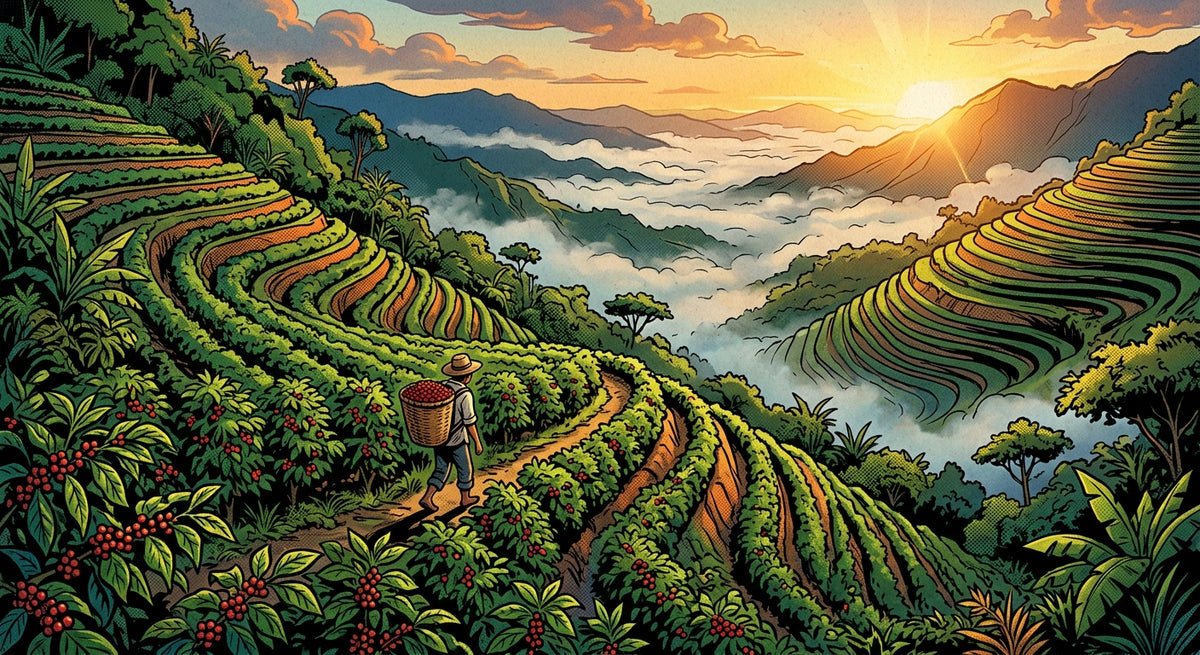
Where does coffee come from is one of those questions that sounds simple until you try to answer it properly. Most people know it grows on a plant somewhere warm. Almost nobody knows how many hands it passes through before it lands in a bag on your bench.
We buy this stuff for a living, so here is the honest version of the trip: from a hillside on the other side of the world to your grinder.
10,000 Kilometres in Your Cup
You tap your card, grab your flat white, and get on with it. Maybe 30 seconds from order to first sip. The coffee itself? It's been travelling for months before it reached that machine.
Most people don't think about it. Why would you? But the beans in your cup crossed oceans, changed hands half a dozen times, and survived a journey that started on a hillside farm in South America, Africa, or Southeast Asia. And every step of that journey shaped how it tastes.
This is the full story. Where our coffee comes from, how it gets here, and why it matters.

It Starts With a Cherry
Coffee doesn't grow as a brown bean. It grows as a bright red cherry on a tree. Inside each cherry, usually two seeds sit face to face. Those seeds are what we call coffee beans.
A farmer picks those cherries by hand (or by machine, depending on the terrain). Then the real work starts. The fruit needs to be stripped away and the seeds need to be dried. How that happens changes everything about the final cup.
Washed (wet) processing: The cherry skin and fruit are removed with water before drying. This gives a cleaner, brighter cup. Most Colombian and Ethiopian coffees are washed.
Natural (dry) processing: The whole cherry dries in the sun with the fruit still on. The bean absorbs sugars from the fruit as it dries. This creates heavier, fruitier flavours. A lot of Brazilian coffees are processed this way.
Once dried to about 11% moisture content, the beans are graded, sorted, and bagged into 60kg jute sacks. Those sacks go into shipping containers. The containers go on ships. And those ships cross the world.

The Journey to Your Cup
Here's the actual supply chain, step by step.
Farmer picks cherries. Cherries are processed (washed or natural). Beans are dried, graded, and packed into 60kg jute sacks. Sacks are loaded into containers at origin. Container ships cross the ocean to Australian ports. Importers in Melbourne and Sydney receive and warehouse the green coffee. We buy from those importers and truck the beans to Perth. We roast them at our roastery in Port Kennedy. Then they go to your cafe or your doorstep.
From cherry to cup, you're looking at 3 to 6 months. And 10,000+ kilometres. For a drink that takes 25 seconds to pour.
If that doesn't make you appreciate your morning coffee a little more, nothing will.
Where We Source From
We don't just buy"coffee." We buy specific lots from specific regions because each one brings something different to the cup. Altitude, soil, climate, variety, and processing all play a role. Two coffees from the same country can taste completely different depending on where exactly they were grown.
Here's what we're currently working with.
| Country | Region | Flavour Profile | Harvest Season |
|---|---|---|---|
| Brazil | Mogiana | Chocolate, nuts, heavy body, low acidity | May to September |
| Colombia | Popayan | Caramel, balanced sweetness, clean finish | Year-round (two harvests) |
| Ethiopia | Yirgacheffe | Blueberry, floral, stone fruit, tea-like | October to February |
| Peru | San Ignacio | Smooth, mild sweetness, soft body | April to September |
| PNG | Okapa | Earthy, herbal, medium body, subtle sweetness | April to August |
Each one plays a different role. Brazil is the backbone of most of our blends. It brings the weight and the chocolate. Colombia is the balancer. Ethiopia is the wildcard that makes things interesting. Peru is the quiet achiever. PNG adds depth and earthiness.
If you want to taste what each origin brings on its own, that's what single origins are for. If you want to know more about that, we broke it down in What Single Origin Actually Means.
Coffee Is a Crop. Not a Factory Product.
This is something that surprises people. Coffee is seasonal. Not every origin is available all year.
Brazil harvests from May to September. Ethiopia from October to February. PNG from April to August. Even Colombia, which produces year-round because it has two growing regions at different altitudes, has better and worse months.
That means the coffee you're drinking right now won't be the same lot you're drinking in six months. The farm, the harvest, the processing batch will be different. The flavour shifts with it.
For single origins, that's part of the appeal. You're tasting a moment in time from a specific place. For blends, it's a problem we solve behind the scenes.
Our blends are designed to taste the same every week. People Everyday should taste like People Everyday whether you buy it in June or December. So when a harvest shifts or a lot changes character, we adjust the ratios. Lean heavier on the Colombian if the new Brazil is running brighter. Pull back the Ethiopian if the new lot is more intense than the last one. The customer never notices. That's the job done right.
The Price of Your Coffee Is Not Fixed
Green coffee is traded on the C-market, which is basically a global commodity exchange. And prices have been climbing. Hard.
Droughts in Brazil. Political instability in Colombia. Shipping costs up. Labour costs up at origin. The cost of the raw beans we buy has been rising for years and it's not slowing down.
Colombian decaf has been hit especially hard. The decaffeination process adds cost on top of already rising green prices. If you've noticed decaf getting more expensive everywhere, that's why.
We absorb as much of this as we can. But it's worth knowing that the price of a bag of coffee isn't pulled from thin air. It reflects a real supply chain with real people at every stage. Farmers, processors, exporters, shippers, importers, roasters. Everyone needs to get paid. And when the cost of any link in that chain goes up, it ripples through.
That's not a guilt trip. It's just the reality. Good coffee costs what it costs because a lot of work went into getting it to you.
Why This Matters to You
You don't need to memorise origin maps or track harvest calendars. That's our job. But understanding the basics makes you a better buyer. You start to notice why your coffee tastes different at different times of year. You understand why some single origins disappear from the shelf for months. You stop falling for marketing that implies coffee just magically appears in a bag.
The tasting notes on the bag make a lot more sense when you know that an Ethiopian washed coffee is a fundamentally different product from a Brazilian natural. They're both coffee. But they're about as similar as a Sauvignon Blanc and a Shiraz.
And when someone tells you their coffee is"ethically sourced" without telling you where it's actually from, you'll know to ask better questions.
Want to taste the origins?
Check out our single origin range and taste each country on its own. Or read What Happens at the Roastery to see what happens after the green beans arrive.
Keep Reading
- What Single Origin Actually Means. The real difference between single origins and blends, and why both matter.
- Tasting Notes Are Mostly Nonsense. Why"candied kumquat" on a bag tells you nothing useful.
- What Happens at the Roastery. The next step in the chain. Green beans in, roasted coffee out.
- Brew Guide. Our full brewing reference for every method.
Written by Jos at Brother of Mine, specialty coffee roasters in Perth.
Keep reading
More from Ground Level.


